
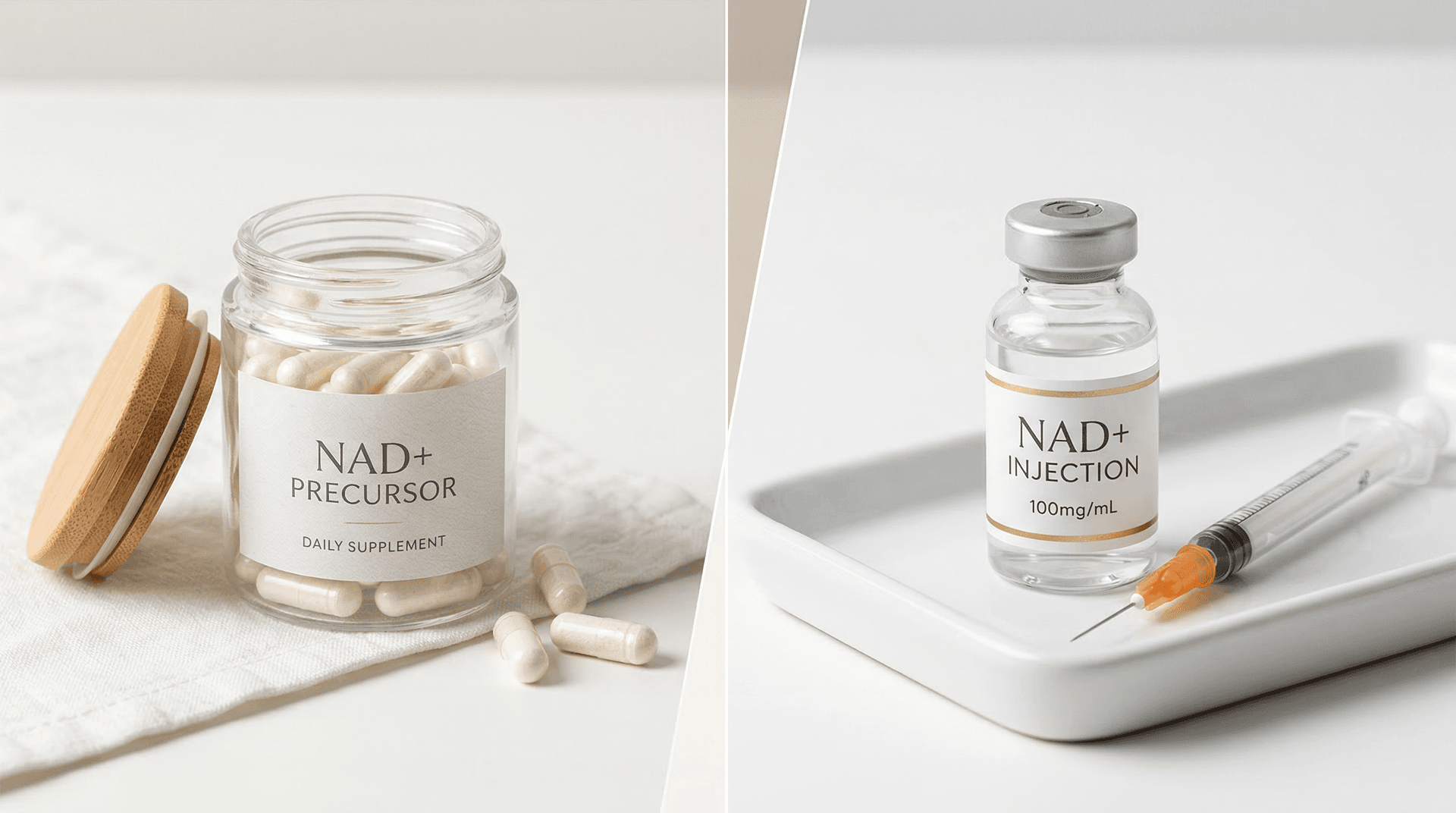
NAD+ Injections vs. NMN Supplements: A Head-to-Head Comparison

Sarah Chen
Medical Content Advisor · February 5, 2026
NAD+ injections and NMN supplements compared across bioavailability, onset, cost, and clinical evidence. Which strategy may fit best?
You have done the reading. You know that NAD+ levels decline with age, and you have seen the headlines about sirtuins, DNA repair, and cellular energy. You are convinced that supporting NAD+ biology is worth exploring. But now you are standing at a fork in the road with two very different options: NMN supplements you can buy online and take as a daily capsule, or NAD+ injections prescribed by a physician and administered at home.
Both aim to support NAD+ levels. Both have some research behind them. But they are fundamentally different approaches with different mechanisms, different evidence profiles, and different practical tradeoffs. This article is a fair comparison to help you think through the decision.
The Basics: What Are NAD+, NMN, and Why Do They Matter?
NAD+ (nicotinamide adenine dinucleotide) is a coenzyme present in every living cell. It plays a central role in energy metabolism, DNA repair, gene expression, and the activation of sirtuins, a family of proteins linked to cellular resilience. Without adequate NAD+, your mitochondria cannot efficiently convert nutrients into ATP, your DNA repair systems slow down, and inflammatory signaling can increase.
The problem is straightforward: NAD+ levels decline with age. A landmark study published in PLOS ONE found significant, measurable decreases in tissue NAD+ concentrations in human subjects across the lifespan [1]. This decline is associated with several hallmarks of aging, including fatigue, cognitive slowdown, metabolic dysfunction, and reduced cellular repair capacity.
NMN (nicotinamide mononucleotide) is a direct precursor to NAD+. Your body naturally converts NMN into NAD+ through an enzymatic pathway. The logic behind NMN supplementation is simple: give the body more raw material, and it can produce more NAD+. NMN is one of several precursors in the NAD+ synthesis pathway, alongside compounds such as NR (nicotinamide riboside) and niacin.
Direct NAD+ therapy takes a different approach. Instead of providing a precursor and relying on downstream conversion, it delivers the finished molecule itself, typically via intravenous infusion or subcutaneous injection.
These are different strategies with different pharmacologic profiles.
Bioavailability: The Central Question
Bioavailability, meaning the proportion of a substance that reaches circulation in a usable form, is one of the most important factors in this comparison.
NMN Oral Supplements
NMN has demonstrated oral bioavailability in human studies. A 2023 clinical trial published in GeroScience showed that oral NMN supplementation at doses of 300 to 900 mg per day safely and significantly increased blood NAD+ concentrations over 60 days, with higher doses generally producing larger increases [2]. That is legitimate evidence that oral NMN can raise circulating NAD+ levels.
However, oral NMN still has to pass through the gastrointestinal tract, be absorbed through the intestinal lining, and then be converted through cellular pathways. There can be variability at each step. Some NMN is degraded before absorption, some is routed through adjacent salvage pathways, and response may differ between individuals based on age, gut health, and enzyme activity.
A 2021 study published in Science by Yoshino et al. demonstrated that 250 mg/day of oral NMN for 10 weeks increased muscle insulin sensitivity in prediabetic postmenopausal women [3]. That study focused on metabolic endpoints rather than subjective energy, but it adds real human evidence that oral NMN can produce biologic effects.
NAD+ Injections
When NAD+ is delivered by injection, it bypasses the entire gastrointestinal system. There is no acid degradation, no intestinal absorption bottleneck, and no need to first convert a precursor into NAD+.
A pilot study published in Frontiers in Aging Neuroscience investigated the pharmacokinetics of intravenous NAD+ in human subjects [4]. The researchers found that during the first two hours of infusion, NAD+ appeared to be rapidly removed from plasma, with measurable downstream metabolite changes becoming more apparent later in the infusion. That study does not directly prove that subcutaneous delivery is superior to oral NMN in every setting, but it supports the idea that parenteral NAD+ behaves differently from oral precursors.
In practical terms, injections offer a more direct route. Oral NMN offers a more convenient route.
The Head-to-Head Comparison
Onset of Effects
| Factor | NMN Supplements | NAD+ Injections |
|---|---|---|
| Time to influence NAD+ biology | Usually requires consistent daily use over days to weeks | Parenteral delivery changes exposure more directly, often on the day of dosing |
| Subjective effects | Usually gradual and variable | Some patients report earlier changes, but response varies |
| Consistency | Depends on daily adherence and oral absorption | Depends on the dosing schedule and injection adherence |
NMN works through a biosynthetic pathway that takes time to influence tissue pools. NAD+ injections deliver the end product directly, which may produce faster pharmacologic exposure, though head-to-head outcome data remains limited.
Dosing and Convenience
NMN has a clear convenience advantage. It is a capsule or powder you can take daily. No prescription is needed, no injection technique to learn, and no medical oversight is required.
NAD+ injections require a prescription, a brief training session on self-injection technique, and a structured weekly or twice-weekly protocol. The tradeoff is precision. You know exactly what compound is being delivered, and you avoid the variability that comes with oral absorption.
Cost
NMN supplements range widely in price and quality. A reputable NMN product at clinically studied doses often costs $50 to $150 per month. However, the supplement market is uneven, and independent testing has shown that label accuracy is not always reliable.
RenuviaRX NAD+ injectable therapy starts at $179/month, which includes physician review, a personalized treatment protocol, and pharmaceutical-grade NAD+ shipped to your door. The cost is higher than many supplement options, but it also includes medical oversight and a regulated pharmacy supply chain.
Quality Control and Regulation
This deserves more attention than it usually gets. NMN supplements are generally sold as dietary supplements, which means they are not subject to FDA pre-market approval. Manufacturers are largely responsible for their own quality control.
Injectable NAD+ prescribed through a telehealth platform like RenuviaRX is compounded by a licensed pharmacy under tighter oversight. That does not guarantee superiority in every clinical outcome, but it does improve confidence in identity, dosing, and handling.
Evidence Base
Let’s be candid about the evidence on both sides.
NMN has a larger body of published human trial data. Multiple randomized, placebo-controlled trials show that oral NMN can raise blood NAD+ levels [2], improve insulin sensitivity in specific groups [3], and show signals in physical performance or sleep-related outcomes.
Direct NAD+ administration has a smaller controlled evidence base. Its rationale is pharmacologically strong because it delivers the molecule directly, but there are fewer randomized trials in healthy human populations than there are for oral precursors.
So the honest summary is this: NMN currently has more published human trial data, while injectable NAD+ has a more direct delivery logic.
The Conversion Question
One of the arguments in favor of injections is that oral precursors depend on absorption and enzymatic conversion, both of which can vary from person to person. That is a real issue, but it should not be overstated. Human trials show that NMN does work for many participants. The question is not whether NMN can work, but whether it works well enough for a given individual and whether the slower, less direct route is acceptable.
For some people, especially those who want a physician-supervised protocol or who have tried oral precursors and felt underwhelmed, that difference matters a lot.
What Patients Report
People who switch from oral NMN supplements to NAD+ injections commonly describe the difference in straightforward terms:
- "I felt the NMN was doing something, but the injections felt more noticeable."
- "My energy feels steadier on a structured injection protocol."
- "I trust the pharmacy product more than whatever I was ordering online."
These reports are subjective, and they are not a substitute for controlled trials. But they do track with the practical advantages patients often care about most: consistency, clarity, and confidence in what they are taking.
Is NAD+ Injection Therapy Right for You?
If you are already using NMN supplements and are happy with the results, there is no urgent reason to change. NMN has legitimate science behind it, and for many people it provides meaningful benefit.
But if you are looking for a more direct, more controlled, and physician-supervised approach, or if you tried NMN and felt the results were modest, injectable NAD+ therapy may be worth considering. The practical advantages of bypassing oral absorption and precursor conversion are real, even if the direct comparative trial evidence is still catching up.
RenuviaRX NAD+ injectable therapy starts at $179/month, prescribed by board-certified physicians, compounded by a licensed pharmacy, and shipped directly to your door. Your protocol is tailored to your health profile, and you have access to clinical support throughout the process.
Take the free assessment at questionnaire.renuviarx.com to see if you qualify
Medical Disclaimer: The information in this article is for educational and informational purposes only and is not intended as medical advice. NAD+ therapy and related services should not be used to diagnose, treat, cure, or prevent any disease or medical condition. Always consult with a qualified healthcare provider before beginning any supplement regimen or health program. These statements have not been evaluated by the Food and Drug Administration. Individual results may vary.
References
Massudi H, Grant R, Braidy N, Guest J, Farnsworth B, Guillemin GJ. Age-associated changes in oxidative stress and NAD+ metabolism in human tissue. PLOS ONE. 2012;7(7):e42357. doi: 10.1371/journal.pone.0042357
Yi L, Maier AB, Tao R, et al. The efficacy and safety of beta-nicotinamide mononucleotide (NMN) supplementation in healthy middle-aged adults: a randomized, multicenter, double-blind, placebo-controlled, parallel-group, dose-dependent clinical trial. GeroScience. 2023;45(1):29-43. doi: 10.1007/s11357-022-00705-1
Yoshino M, Yoshino J, Kayser BD, et al. Nicotinamide mononucleotide increases muscle insulin sensitivity in prediabetic women. Science. 2021;372(6547):1224-1229. doi: 10.1126/science.abe9985
Grant R, Berg J, Mestayer R, et al. A pilot study investigating changes in the human plasma and urine NAD+ metabolome during a 6 hour intravenous infusion of NAD+. Frontiers in Aging Neuroscience. 2019;11:257. doi: 10.3389/fnagi.2019.00257
Ready to start your wellness journey?
Take a free online assessment and get physician-supervised therapy delivered to your door.
GET STARTED →